 OceanLog™
We don't replace coaches. We make them impossible to forget.
Your athletes log between lessons. You arrive with a two-minute brief, in your voice, on your syllabus.
€19.99 a month
One coach seat, or €199.90 a year — 2 months free. VAT included.
Up to 25 athletes
Log free on your seat. They never see a paywall.
First month free
No card. Open beta until 30 September. Free + paid plans from 1 Oct.
Which one are you? One tap.
One week, one loop.
Tap + on any step to see it in the app.
-
1
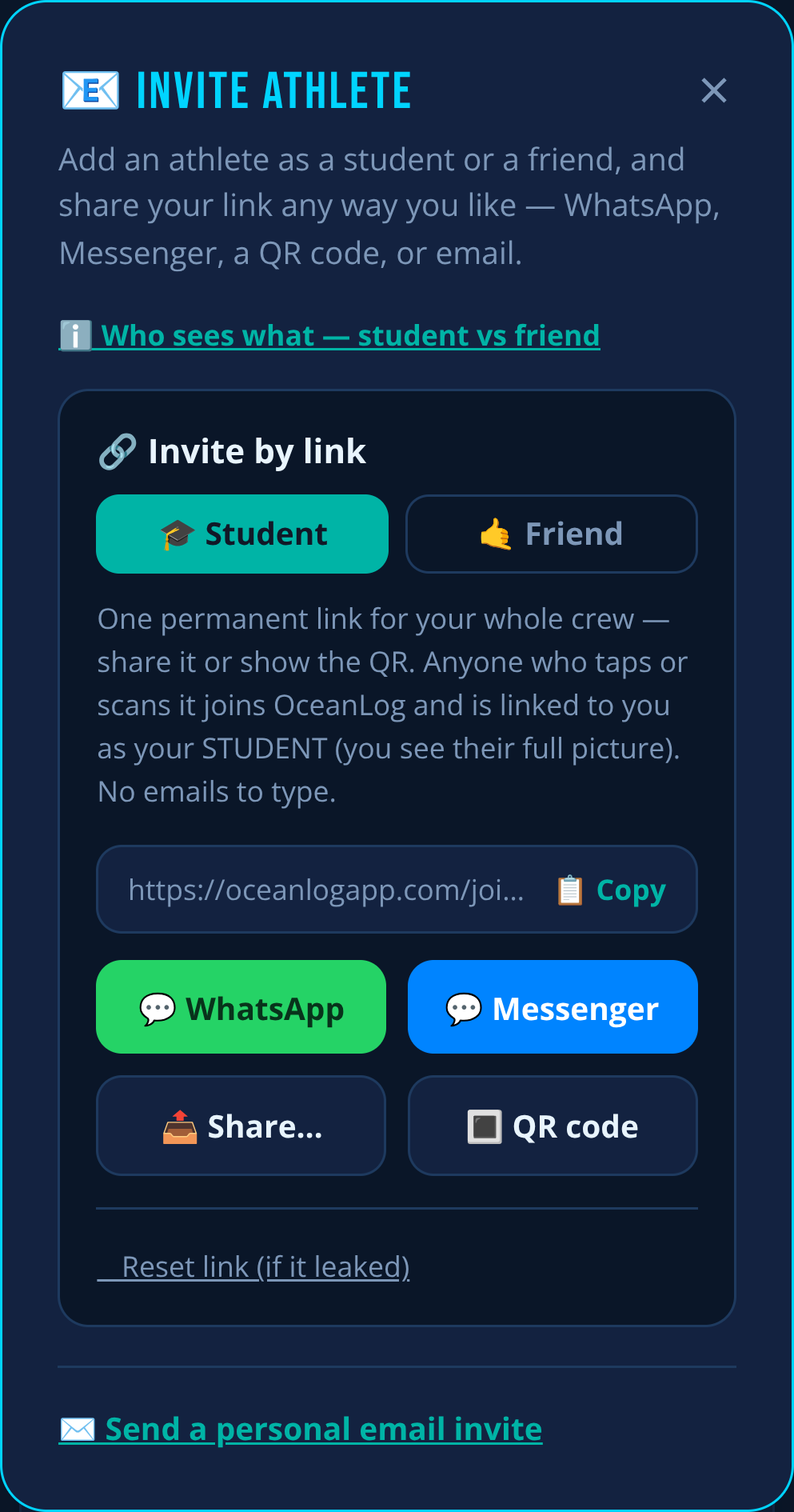
You invite an athlete
Full app, free on your seat.
-
2
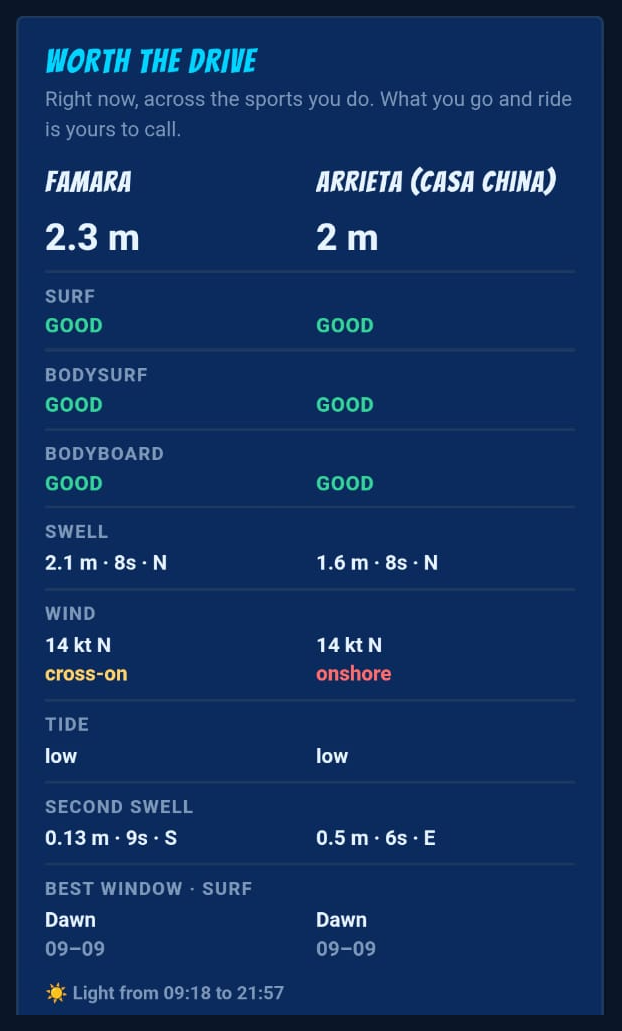
Worth the drive?
The forecast read against each student’s level and quiver.
-
3
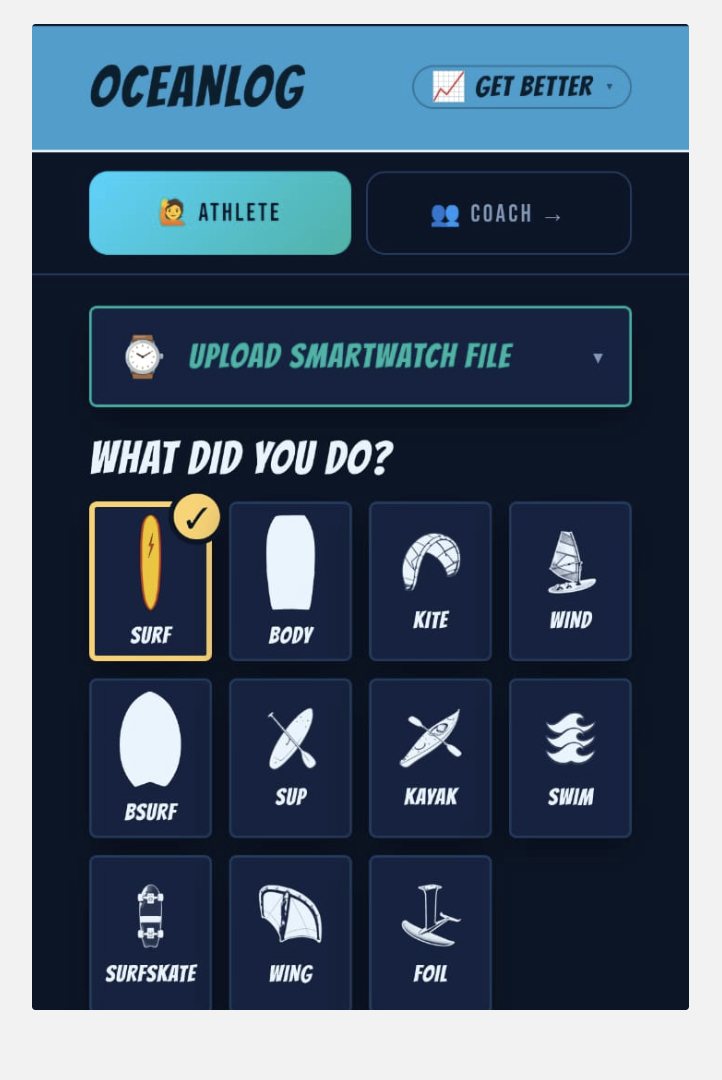
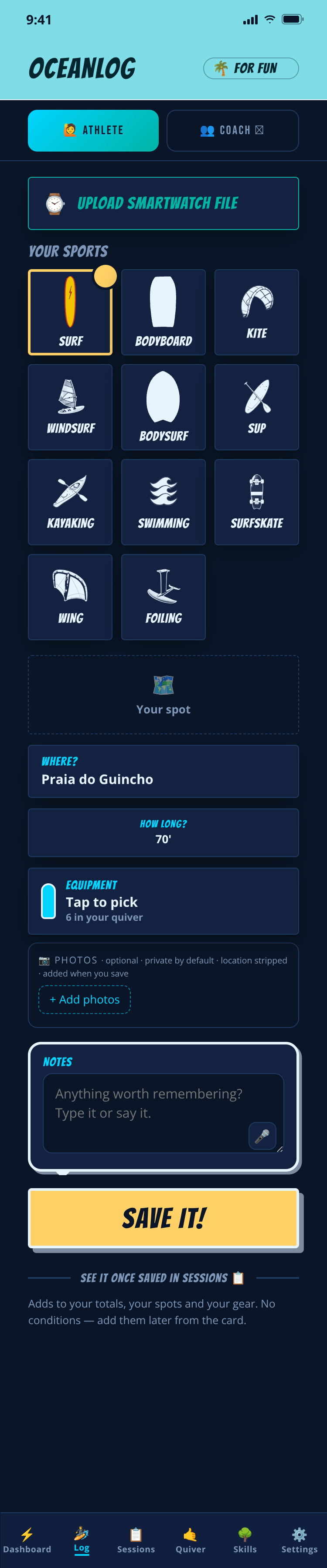
They log, in about a minute
Swell, wind, tide fill themselves in.
-
4
The session is read back
Plain language, flagged where data is thin.
-
5
In your voice
Your tone, your syllabus names.
-
6
You coach
The part nobody does better.
- 1You invite an athlete. Full app, free on your seat.
- 2Worth the drive? The forecast read against each student’s level and quiver.
- 3They log, in about a minute. Swell, wind, tide fill themselves in.
- 4The session is read back. Plain language, flagged where data is thin.
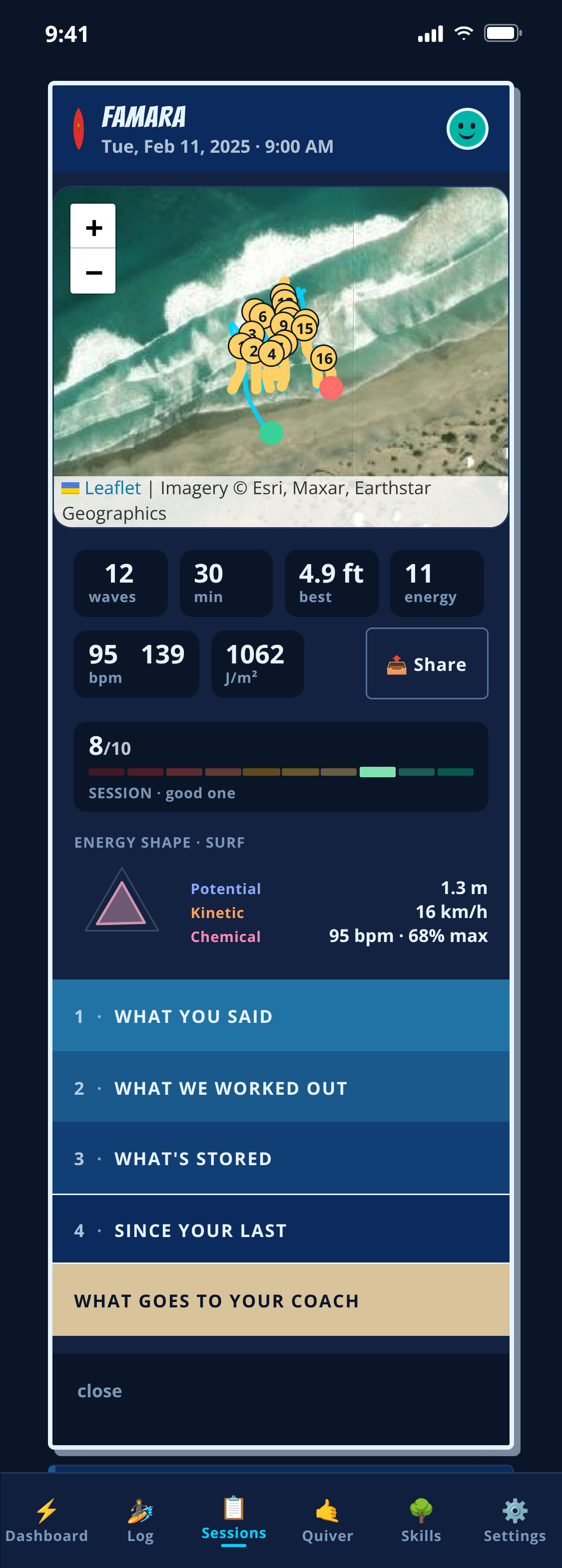
- 5In your voice. Your tone, your syllabus names.
- 6You coach. The part nobody does better.
↺ and back to 1
An app can describe a session. It cannot coach a person.
“I teach pilots and cabin crew how a crew should work together as a team. The trust between two people is what makes the flying safe. The instruments help. They never fly the plane unsupervised.”
It never grades
No score, no verdict, no ranking. Judgement is yours.
It says when it doesn’t know
Thin data labelled thin. Estimates labelled estimates.
No drills over your head
It suggests what to look at. Never contradicts you.
Your athletes are yours
No marketplace, no bidding war, no marketing to them.
AI, always named
Nobody thinks a machine’s summary came from you.
Everything a coach needs between two lessons.
The arrival briefing
A two-minute read: what they did since you last saw them, and where you can help.
A weekly read per athlete
One report per athlete, per week, from their own logs — with you or away from you.
Progression tree, per sport, per board
Tailored to the programme you teach. Some rows only a coach can fill.
One roster, every sport
Each sport you coach with its own fields, gear and language. Cross-training stops being invisible.
Energy shapes
Drawn, not written: working with the elements, or against them?
Gear against the day
Every board read against the conditions it met — explained for you and the student.
Numbers, when there are numbers
Watch files import themselves. No watch? It still works, and says when it estimated.
One seat. Your athletes log free.
2 minprep per athlete, down from twenty
25athletes on one coach seat
€0what your athletes pay
30 daysgrace when an athlete leaves you
+1 monthfor you, when one subscribes
“Good news — Marta just subscribed independently. You've earned a free month, and a coaching seat is open again.”The message you get at step four.
How the seat works
- 1You invite an athlete. Full access on your seat, free to them.
- 2They log; history builds. Every session joins their record — and yours.
- 3They leave coaching. Thirty days of grace. Nothing deleted unless they ask.
- 4They subscribe on their own. The seat frees, and a month is credited to you.
- 5You invite the next one. The roster stays fresh.
- 6Referrals. An athlete shares their best wave; a friend becomes step 1.
Time figures compare coaching a roster by hand with reading a prepared page — not a measured study. 1% of every subscription goes back to the ocean.
Open what you need. Skip the rest.
Your syllabus, your languageWe adjust to your method, not the other way round.
The vocabulary is yours
Name your stages; reports use your words first, the athlete’s second.
Encouraging, direct, technical or plain
Set once per coach, override per athlete. Spanish, Catalan, German, Polish and more.
Mapped onto the skills tree
Re-label stages to match the levels you already award, alongside the frameworks working coaches use.
Your method stays yours
Never learned from, trained on or shared. It leaves with you.
Schools and clubs too
Groups through the same loop, per-athlete history, consent-gated pairing.
We claim no affiliation with, or endorsement by, any coaching programme or governing body.
What you see, and what you don’tConsent is the whole design.
Pairing is opt-in, and revocable
Nothing is visible to a coach who wasn’t invited. No back door.
Heart rate is off by default
Health data, shared only by explicit choice.
Secret spots stay secret — from you too
Redacted everywhere, including the AI’s own input.
Your notes are yours
Private by default. Every acceptance recorded.
European data protection
GDPR and Spain’s LOPDGDD: consent logged, access, export and erase on request, no selling, no training.
Minors and adaptive athletes
Coming deliberately slowly, legal before fast. For now, adults who consent for themselves.
Questions coaches askWatches, contradictions, exports, getting started.
Do my athletes need watches?
No. Watches only add numbers: .FIT, Apple Health, GPX or TCX.
Will it contradict me?
It isn’t built to. It describes, suggests, and defers the call to you.
An athlete already pays?
They keep their account and simply pair with you. Nothing lost.
Can I export what I’ve built?
Yes — exportable and deletable on request.
How do I start?
Email Xisco; he sets it up with you by hand. One athlete or twenty.
Our valuesEvery athlete. Every identity.
Pronouns
He, she, they or custom — LGBTIQ+ inclusive, in every language.
Communication
WhatsApp, email or phone. Each athlete chooses.
Tone
Adapted to age, level and preference, under your setting.
Accessibility
WCAG by design, with visually impaired athletes and adaptive surfing. Done right, not fast.
The planv1.0 on 1 Oct 2026.
29 Aug 2026 · Open beta
No invite, no card. First month after launch free too.
Now · More sports
eight sports live. Windsurf, wing and foiling in build.
1 Oct 2026 · v1.0
First paying subscribers.
2027 → Native apps
iOS and Android.
Bring one athlete. See what next Tuesday feels like.
Tailored for you by Xisco — he replies personally. School or club? → · Términos para Entrenadores